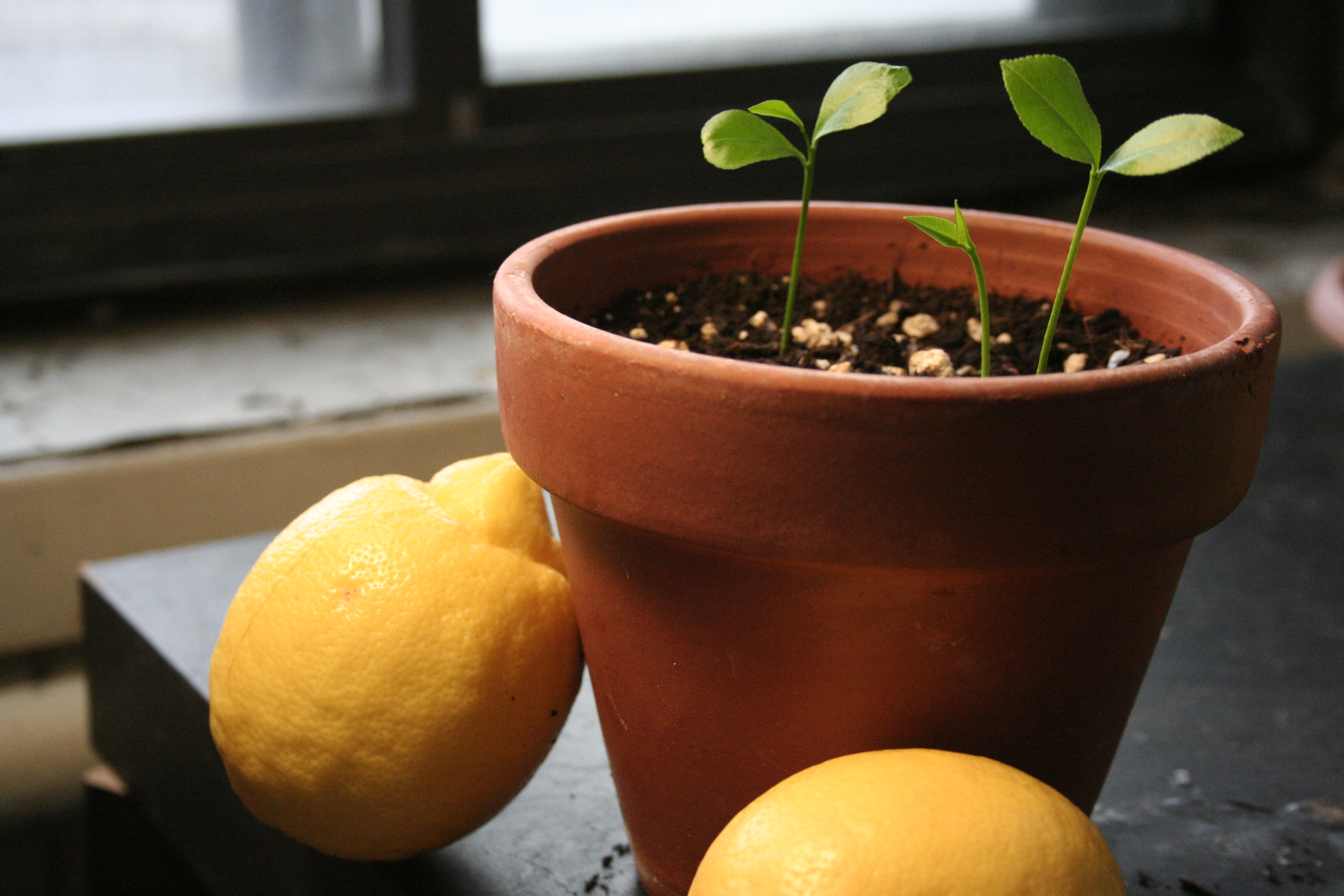
If you’ve ever seen a flowering lemon tree, you’ll understand why. For those of you who haven’t, allow me explain. Their lush, dark green, oval leaves have a glossy texture that shimmers in sunlight. Their delicate white flowers bloom with a citrus fragrance and are soft to the touch. Their exotic nature provides an alluring quality. And, finally, they bear the exciting possibility of fruit!
Typically, lemon trees flourish outdoors year-round in hot, sunny regions, but they can also thrive indoors as edible houseplants in cold-season climates. At the organic food store where I work we have a healthy lemon cutting producing massive fruit in a garage setting all year. It makes for an impressive sight during the dead of a Canadian winter!

This is the little tree with big fruit in the shop I work at.
And while rooting cuttings is a sensible option for fast fruit, lemon tree cuttings are not readily available in many parts of the world. But lemons are another story. And although it may take anywhere from 3-6 years for your tree to be capable of producing fruit, there is something extra rewarding about starting from seed. I currently have six strong little seedlings on the go, all of which were germinated in the middle of winter with very little effort. Watching them grow has been an exciting and fascinating experience and I know the best is yet to come.
Here is a step-by-step guide to growing your very own lemon tree from seed:
Things you’ll need:
1. A lemon. Make sure you purchase an organic lemon since some non-organic lemon seeds may be “duds”, incapable of germinating. Any organic lemon will do, but if you have climate or space restrictions, you may want to try looking for a specific variety called a “Meyer” lemon. Meyer lemons are a smaller type of lemon, often grown for ornamental purposes, and are thus better suited for indoor containers. I chose Meyer seeds for these reasons, but you can use any seed that makes sense for your situation.

This is a Meyer lemon!
2. Potting soil. I would guess that any potting soil will do, but I suggest using one with a blend of peat, perlite, vermiculite, and organic fertilizer. Every single one of the seeds I planted in this type of certified organic potting mix have sprouted beautifully, so I think it’s fair to say that it works.
3. Container/pot. A container (with drainage holes) that is 5-6” deep and a few inches in diameter will be sufficient for sprouting; however, the seedling will need to be re-potted into a much larger container. Mature lemon trees prefer a container that is wider rather than deeper, so I suggest planting your seedling in a pot that is 10-16” deep and 12-18” in diameter. Your baby tree will happily make itself at home in this larger container for the next few years, at which time you may want to upgrade again.
4. A grow light or lots of sun. Lemon trees need a lot of light, especially when they are sprouting and require 10-14 hours of it each day. If you don’t have a consistently sunny window (like me), get a grow light. They don’t cost much and will prove their worth in healthy green foliage.
Method for sprouting the lemon seed:
1. Pre-moisten your potting soil. Put some soil into a bucket and mix in some water until the soil is damp all the way through.
2. Fill your container with the pre-moistened soil. Leave about an inch of space below the rim of your container.
3. Slice open your lemon and choose a seed that looks completely full of life. Pop it into your mouth and suck on it until all the flesh is removed and the lemon flavour is gone. Do not allow the seed to dry out at any time. It needs to stay moist in order to germinate. I suggest keeping it in your mouth until you’re ready to plant.
4. Plant your seed! While it’s moist, plant your seed about 1/2″ below the soil level. Cover it completely with soil and water well with a squirt bottle or gentle watering can.
5. Cover your container with breathable plastic to keep your seeds warm and moist. I used a piece of clear garbage bag with holes poked into it and a rubber band to securely hold it in place.
6. Place the container in a warm location and observe for the next few days. Keep in mind: your seed needs warmth and moisture in order to germinate. Don’t allow the potting soil to dry out completely. Also take caution that you don’t cook your seed in its little greenhouse. Too much heat and moisture could lead to a rotten seed! You’re aiming to achieve a nice balance, so if you feel like the soil is warm enough without the plastic then it’s probably safest to remove it.
7. In about two weeks you may notice a sprout emerging from the soil. Once it appears, remove the plastic (if it’s still on) and place the little guy in a warm location with plenty of direct sunlight. Supplement sun with your grow light if needed.

Here are my little guys one month after planting.

At a little less than two months old, this little guy is upgrading to a larger home.
8. Care for your new baby and watch it grow! Provide it with:
- Water. Ensure that the soil is damp at all times, especially when your lemon tree is young. Do not allow it to sit in a puddle of stagnant water though; those drainage holes are there for good reason.
- Sunlight. Place it in a warm sunny window where it will receive eight hours of direct sunlight each day, or supplement some sun for a grow light. Since Toronto rarely seems to get any sun in the winter, my sprouts reside in a well-lit window under the warm rays of a grow light for 12 hours each day.
- Food. In order to keep your lemon tree healthy and growing the soil will eventually need to be replenished with nutrients. I suggest feeding it an organic fertilizer, such as compost or vermicompost, once it has developed a nice little set of leaves. Dig a little trench around the base of your tree, fill it with compost and water it well. Or, serve it up as compost tea. Try feeding it twice a year or as needed, but do not overfeed! When it comes to fertilizing, less it best; so if in doubt, put it off a bit longer. (Another option is to start your seed in potting soil with vermicompost or worm castings mixed into it).
- Love. Spend some time looking at your new citrus friend. Pay attention to its growth. Feel it, talk to it, sing to it, but don’t try to dance with it. Get into the habit of watching for browning leaves and checking the underside of leaves for pests. Just like us, our plants can fall victim to bugs and disease and may sometimes require some extra love and affection.
Sent from my iPhone


